Why AI Workloads Are Rewriting Data Center Power Budgets
Foreword
Last time we talked about egress fees — the cost line that quietly decides your cloud bill. This time the meter moves further upstream: electricity itself. AI workloads have changed how data centers consume power, and the change is big enough to reshape budgets, site selection, and even which projects get approved. This article explains why power became the new bottleneck, where the money actually goes, and what it means if you rent servers instead of building data centers.
Why AI Breaks the Old Math
Traditional racks were predictable. A web server rack drew five to ten kilowatts, cooling was a fixed multiplier, and capacity planning meant counting racks.
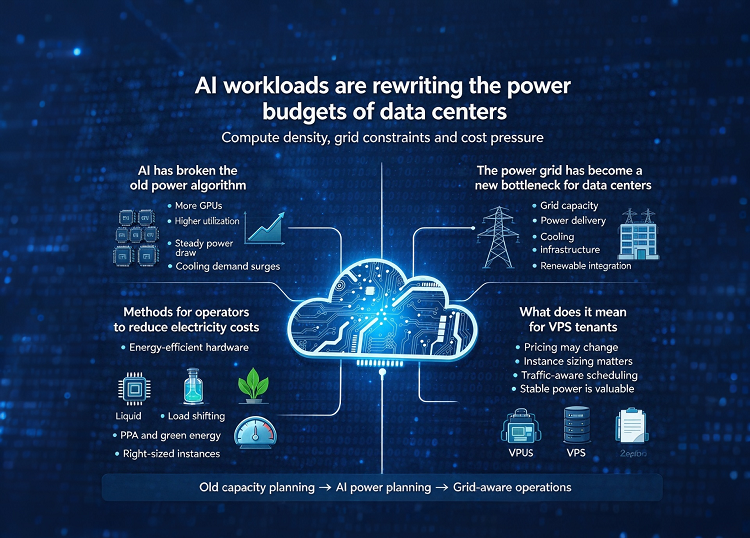
AI changes the numbers. A single GPU server can draw as much power as a small rack of web servers. Dense AI racks built for training clusters go far beyond that — flagship liquid-cooled racks now exceed one hundred kilowatts. Same floor space, roughly ten times the power, and cooling systems designed for the old math stop being adequate.
There is a second twist: idle does not mean off. GPUs in an idle cluster still draw a large share of their peak power, so “we will scale down at night” saves less electricity than people expect.
Where the Power Budget Actually Goes
A data center power budget has three big lines: IT load, cooling, and conversion losses. PUE — power usage effectiveness — describes the multiplier: a PUE of 1.5 means every kilowatt of servers costs half a kilowatt more in overhead.
The arithmetic is simple. A facility with 1 megawatt of IT load at PUE 1.2 draws 1.2 megawatts in total. The same IT load at PUE 1.5 draws 1.5 megawatts — 300 kilowatts of extra draw, paid every hour, for the same computing work. This is why operators fight over PUE decimals the way traders fight over latency.
The Grid Is the New Bottleneck
For years, the constraint was money: build the building, buy the gear. Now the constraint is power. Utilities in many markets have multi-year waits for new high-capacity connections, and some regions already limit how much data centers may draw.
The consequence shows up in site selection. “Where is the tax break” is slowly being replaced by “where is the power”. Operators that run their own facilities have an easier time answering these questions — for example, VMRack operates out of its self-built data center at Equinix LA4 in Los Angeles, where power and network decisions sit under one roof instead of being spread across landlords.
What Operators Are Doing About It
Four moves dominate right now:
Liquid cooling. Direct-to-chip loops handle rack densities that air cannot, and they cut the cooling multiplier at the same time.
Power capping. Firmware limits on GPUs trade a little peak performance for a much flatter power curve.
Scheduling. Batch training jobs shift to off-peak hours and low-carbon windows, easing both grid stress and cost.
Supply strategy. Renewable PPAs and on-site generation hedge against both price swings and grid queues.
None of these are free. All of them show up in someone’s budget — the open question is whose.
What It Means for Tenants
If you rent VPS or colocation space, power costs reach you indirectly, through prices and capacity waits. Three practical takeaways:
Ask about PUE and cooling design before you commit. A facility that cannot answer these questions is a facility whose prices you cannot predict.
Expect AI-heavy providers to prioritize GPU capacity. General-purpose availability may tighten even when “capacity” sounds fine on the sales page.
Remember that electricity is regional. The same workload can carry a very different power price — and a very different carbon profile — depending on where the data center plugs in.
And the older rules still apply. Egress fees did not disappear because AI showed up; they stack on top of power-driven pricing changes.
Conclusion
AI workloads turn data center power from a fixed background cost into the variable that shapes everything: rack design, site selection, and the price of the next server you rent. Operators who control their power curve will move faster. Tenants who understand the power budget will read their future invoices better. The meter is running upstream now — that is the trend to watch.
Thank you very much for reading to the end!
Related Reading
Why Egress Fees Still Rule the Cloud in 2026 (And How to Estimate Yours)
From AI to SI: How the US-China Tech Race Is Driving Up Global Cloud Infrastructure Costs